In the information age, nutrition has become a battlefield of ideologies. Scroll through social media in 2025, and you will find a cacophony of conflicting advice: one influencer claims oatmeal is a “superfood,” while another brands it “toxic sludge.” One doctor advocates for six meals a day, while another swears by one.
For the average person trying to stay healthy, this noise is paralyzing.
The problem lies in the simplification of complex biochemistry. Nutrition is rarely black and white; it is a spectrum of context. However, myths persist because they offer simple solutions to difficult problems. They cling to our collective consciousness, passed down from generation to generation, often causing us to fear perfectly healthy foods or waste money on unnecessary protocols.
This article cuts through the noise. We have analyzed the latest data from metabolic science and nutritional epidemiology to dismantle 15 of the most pervasive nutrition myths. It is time to unlearn what you thought you knew and rebuild your diet on a foundation of evidence, not anecdote.
Part 1: The Macronutrient Wars
The most heated debates in nutrition usually center on the “Big Three”: Carbohydrates, Fats, and Proteins.
Myth 1: Carbs Make You Fat
The Truth: Excess calories make you fat; carbohydrates are merely a fuel source. The vilification of carbohydrates—driven by the Keto and Carnivore movements—ignores the fundamental laws of thermodynamics. A 2024 meta-analysis confirmed that when protein and calories are equated, low-carb diets result in statistically similar fat loss to high-carb diets.
-
Nuance: The type of carb matters. Refined carbohydrates (sugar, white flour) spike insulin and encourage overeating due to low satiety. Complex carbohydrates (oats, quinoa, tubers) are high in fiber and essential for gut health. Blaming a potato for the obesity crisis caused by donuts is scientifically inaccurate.
Myth 2: Eating Fat Makes You Fat
The Truth: Dietary fat does not directly translate to body fat, but it is calorie-dense. For decades, the “low-fat” craze of the 90s taught us that eating an avocado would clog our arteries. We now know that healthy fats (monounsaturated and polyunsaturated) are vital for hormone production and brain function.
-
-
The Trap: While fat doesn’t spike insulin like sugar, it is the most energy-dense nutrient (9 calories per gram vs. 4 for carbs/protein). You can indeed gain weight on a “healthy” Keto diet if you consume unlimited nuts and oils.
-
Myth 3: You Can Never Eat Too Much Protein
The Truth: The body has a limit on how much protein it can use for muscle synthesis. The “Gym Bro” culture often pushes protein intakes exceeding 3g per kilogram of body weight. However, research indicates that for natural athletes, benefits plateau around 1.6g to 2.2g per kg.
-
The Outcome: Excess protein is not stored as “extra muscle.” It is deaminated by the liver—meaning the nitrogen is removed—and the remaining structure is burned for fuel or, in a caloric surplus, stored as fat.
Part 2: Metabolic Mechanics & Timing
These myths prey on our fear that our metabolism is a fragile machine that will break if we don’t adhere to a strict schedule.
Myth 4: “Starvation Mode” Stops Weight Loss
The Truth: You cannot defy physics; true starvation mode is rare in developed nations. Many people believe that if they eat too little, their body will “hold onto fat.” This is a misunderstanding of Adaptive Thermogenesis. Yes, as you lose weight, your metabolic rate drops slightly because you are a smaller person moving less mass. However, your body will never stop burning fat in a significant caloric deficit.
-
Reality Check: If “starvation mode” caused weight gain, famine victims would be obese. The stalling on the scale is usually due to water retention or tracking errors, not a metabolic shutdown.
Myth 5: You Must Eat Small, Frequent Meals to Boost Metabolism
The Truth: Meal frequency has a negligible effect on total daily energy expenditure (TDEE). The theory was that eating keeps the metabolic fire burning via the Thermic Effect of Food (TEF). However, TEF is proportional to total calories, not frequency.
-
The Math: Eating 2,000 calories in one meal or six meals results in roughly the same digestion energy burn. For many, grazing all day simply provides more opportunities to overeat.
Myth 6: Breakfast Is the “Most Important Meal of the Day”
The Truth: Breakfast is optional. This slogan was largely a marketing invention by cereal companies in the early 20th century. While breakfast is crucial for growing children, adults can function perfectly well without it.
-
Intermittent Fasting: Millions of people skip breakfast (16:8 fasting) and see improvements in insulin sensitivity and mental clarity. If you are hungry in the morning, eat. If not, don’t force it.
Myth 7: Eating at Night Causes Weight Gain
The Truth: Calories eaten at 8:00 PM count the same as calories eaten at 8:00 AM. While chrononutrition (discussed in other articles) shows that insulin sensitivity drops at night, weight gain is ultimately driven by the total intake.
-
The Context: The reason night eating is associated with obesity is behavioral, not physiological. People rarely binge on steamed broccoli at midnight; they binge on ice cream and chips while sedentary on the couch.
Part 3: The “Health Halo” and Purity Myths
Marketing teams are experts at making products appear healthier than they are, leading to myths about food “purity.”
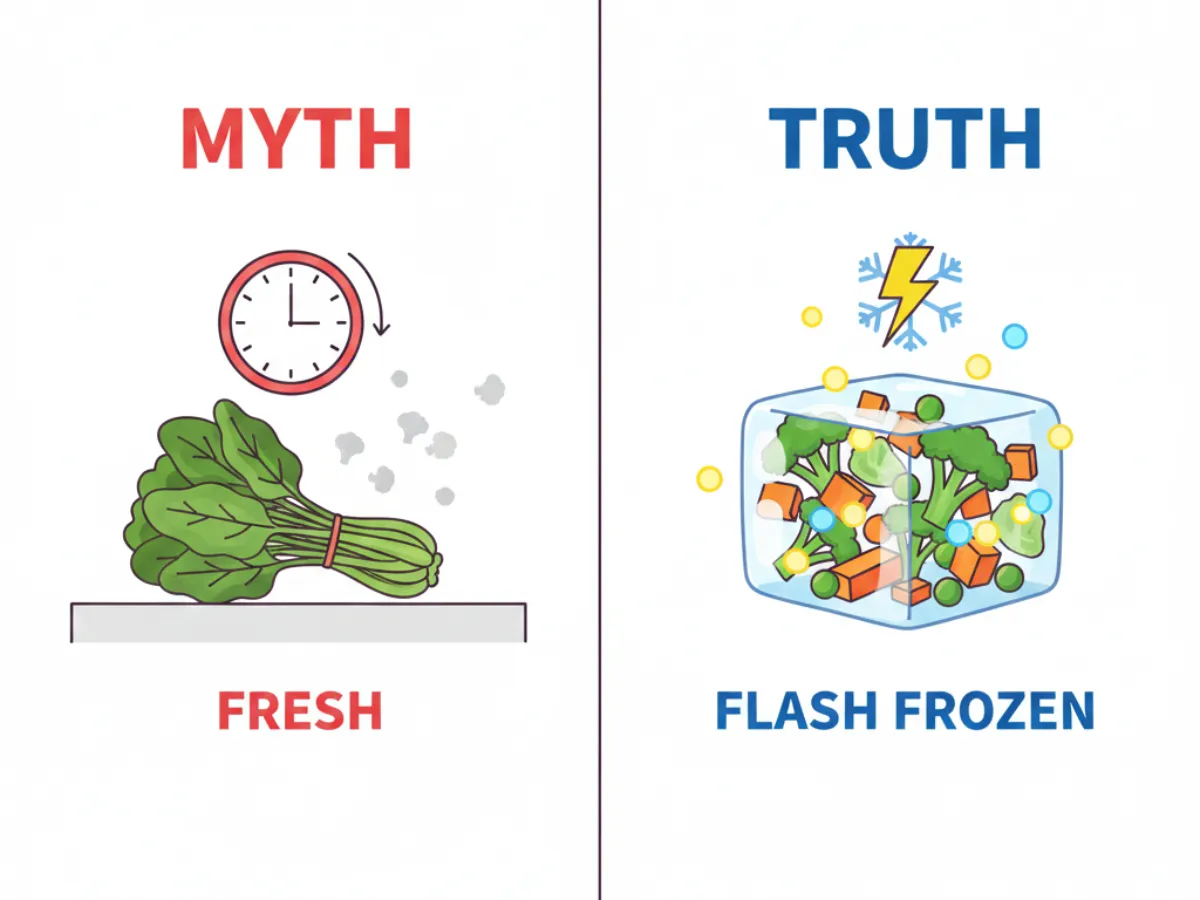
Myth 8: Fresh Produce Is Always Better Than Frozen
The Truth: Frozen vegetables often contain more nutrients than fresh ones. “Fresh” spinach may travel for two weeks on a truck, sitting under oxidation-inducing lights in a supermarket, losing up to 50% of its Vitamin C.
-
The Frozen Advantage: Frozen produce is picked at peak ripeness and flash-frozen within hours, locking in the nutrient profile. They are also often cheaper and reduce food waste.
Myth 9: Gluten-Free Means Healthy
The Truth: For non-celiacs, gluten-free processed foods are often nutritionally inferior. Unless you have Celiac disease or non-celiac gluten sensitivity (roughly 6% of the population combined), avoiding gluten has no proven benefit.
-
The Trade-off: To mimic the texture of gluten, manufacturers use tapioca starch, rice flour, and xanthan gum. These alternatives are often lower in fiber and protein and higher in sugar than their whole-wheat counterparts.
Myth 10: You Need to “Detox” or “Cleanse”
The Truth: Your body has a built-in detox system; it’s called your liver and kidneys. Juice cleanses and detox teas are a multi-billion dollar scam. There is no accumulation of “sludge” in your intestines that a tea can wash away.
-
-
The Risk: Most “detox” products are simply laxatives or diuretics that cause water weight loss, not fat loss, and can strip your gut biome of healthy bacteria.
-
Myth 11: Organic Food Is More Nutritious
The Truth: “Organic” refers to farming methods, not nutrient density. A 2012 Stanford University meta-analysis (and subsequent updates) found very little difference in vitamin content between organic and conventional produce.
-
The Real Reason: Buy organic to reduce exposure to synthetic pesticides or to support sustainable farming practices, but do not assume an organic cookie is a health food. It is still a cookie.
Part 4: Weight Loss & Specific Ingredients
Finally, we address the myths that surround specific ingredients and the mechanics of losing weight.
Myth 12: You Can “Spot Reduce” Fat
The Truth: You cannot choose where you lose fat. Doing 100 crunches a day will build muscle in your abs, but it will not burn the layer of fat covering them. Fat loss occurs systemically.
-
Genetics: Your body decides where to pull fat from based on genetics and hormones. For many, the stomach is the first place fat is stored and the last place it leaves.
Myth 13: Supplements Can Replace a Bad Diet
The Truth: You cannot out-supplement a nutrient-poor lifestyle. Multivitamins are an “insurance policy,” not a solution. Real food contains thousands of phytochemicals, fiber types, and enzymes that work synergistically and cannot be replicated in a pill.
-
Bioavailability: The body absorbs nutrients from food far more efficiently than from synthetic isolates.
Myth 14: “Low-Fat” or “Low-Sugar” Labels Mean Healthy
The Truth: When one element is removed, another is usually added to maintain flavor.
-
The Low-Fat Era: In the 1990s, fat was removed from yogurts and cookies, but it was replaced with massive amounts of sugar to make the product palatable.
-
The Artificial Trap: “Sugar-free” often means loaded with sugar alcohols (like maltitol) which can cause severe digestive distress and may still negatively impact the gut microbiome.
Myth 15: Eggs Raise Your Cholesterol and Heart Risk
The Truth: Dietary cholesterol has a minimal impact on blood cholesterol for most people. For decades, the 185mg of cholesterol in an egg yolk was feared. However, the liver produces the vast majority of cholesterol in your body. When you eat more, your liver produces less to compensate.
-
The Verdict: Current health guidelines generally accept that eating whole eggs (including the yolk, which contains choline and B vitamins) is safe and heart-healthy for the majority of the population.
Conclusion: Be a Skeptic, Not a Cynic
The landscape of nutrition is constantly evolving. A “fact” today may become a “myth” in ten years as measurement tools improve and long-term studies conclude. This does not mean science is broken; it means it is working.
The danger lies in dogma—believing that there is only one way to eat. The myths debunked above share a common thread: they attempt to apply a rigid rule to a flexible biological system.
Your Next Step: Choose one myth from this list that you currently follow (e.g., “I avoid fruit because of sugar” or “I force myself to eat breakfast”). For the next 14 days, drop that rule. Listen to your body’s biofeedback. Do you feel more energetic? Less stressed? Use your own experience as the final data point.
FAQs
1. Is microwaving food bad for nutrients? No. In fact, microwaving can be one of the best ways to preserve nutrients. Because it cooks food quickly and uses very little water, water-soluble vitamins (like Vitamin C and B vitamins) are retained better than in boiling or poaching.
2. Is sea salt healthier than table salt? Minimally. Sea salt contains trace minerals like magnesium and calcium, but in amounts so small they are negligible for health. The primary difference is texture and taste. Note that table salt is often fortified with iodine, a crucial nutrient for thyroid health that sea salt lacks.
3. Does red meat cause cancer? The WHO classifies processed meat (bacon, sausage) as a Group 1 carcinogen and red meat as a Group 2A “probable” carcinogen. However, the risk is dose-dependent. Occasional consumption of unprocessed, high-quality lean red meat is widely considered safe, whereas daily consumption of processed meats poses a higher risk.
4. Do I really need to drink 8 glasses of water a day? This is an old guideline with no specific scientific backing. Hydration needs vary by size, activity, and climate. You also get about 20% of your water from food. The best indicator is urine color: if it is pale yellow, you are hydrated. If it is clear, you are over-hydrated.
5. Are “Superfoods” real? “Superfood” is a marketing term, not a scientific one. While foods like kale, blueberries, and salmon are incredibly nutrient-dense, no single food can save a bad diet. A variety of standard vegetables is better than relying on expensive “superfood” powders.
References
-
National Institutes of Health (NIH) – Dietary Fats and Health: https://www.ncbi.nlm.nih.gov/pmc/articles/PMC5577766/
-
Harvard T.H. Chan School of Public Health – The Egg and Cholesterol Myth: https://www.hsph.harvard.edu/nutritionsource/what-should-you-eat/fats-and-cholesterol/cholesterol/
-
Stanford Medicine – Organic vs. Conventional Food Study: https://med.stanford.edu/news/all-news/2012/09/little-evidence-of-health-benefits-from-organic-foods-study-finds.html
-
Journal of the International Society of Sports Nutrition – Meal Frequency: https://jissn.biomedcentral.com/articles/10.1186/1550-2783-8-4