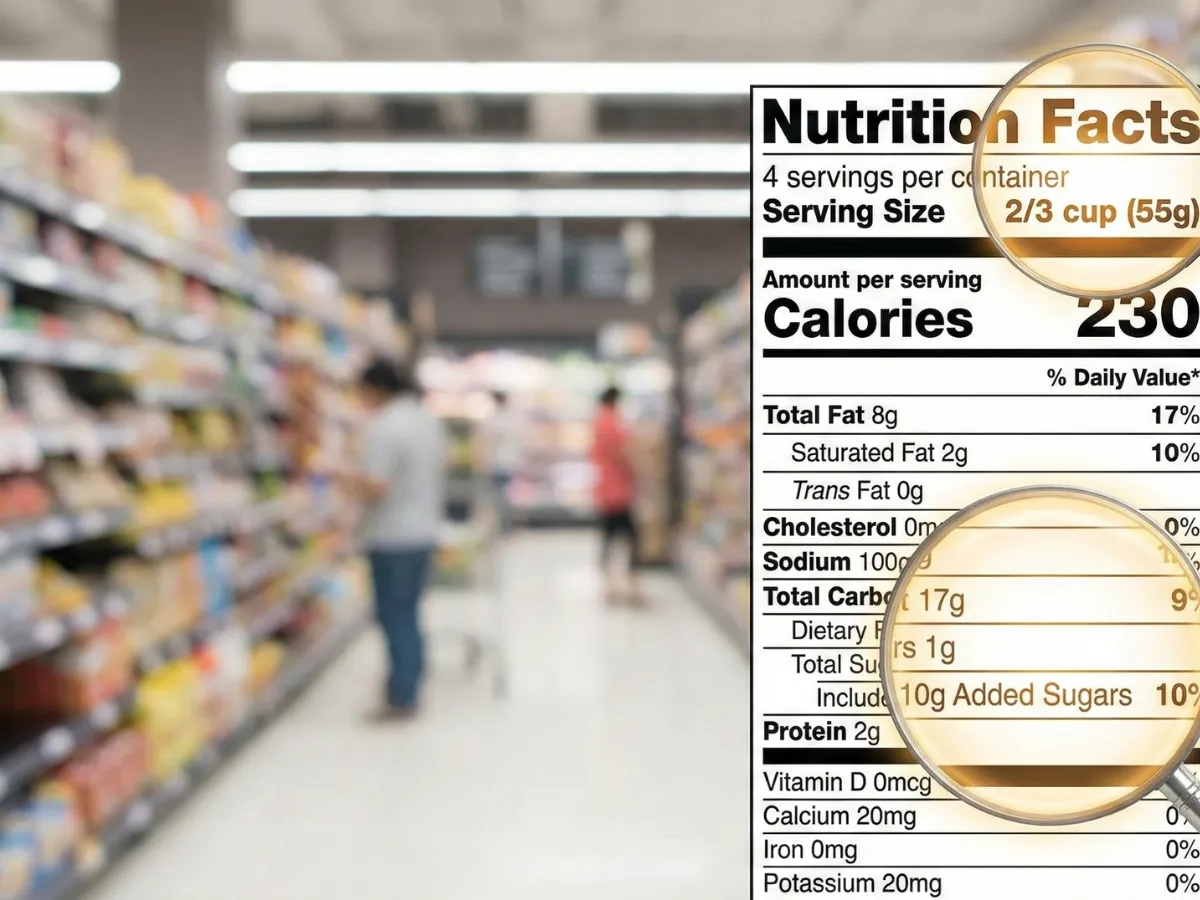
The modern supermarket is a minefield of marketing. Brightly colored boxes scream promises of “natural ingredients,” “heart health,” and “guilt-free” snacking. Yet, turn the package over, and the black-and-white Nutrition Facts label often tells a drastically different story.
For the average consumer in 2025, distinguishing between genuine nutrition and clever advertising has never been more difficult. A study by the FDA found that while most consumers glance at labels, fewer than half truly understand how to interpret the data, particularly regarding serving sizes and percentage daily values (%DV). This knowledge gap is where healthy intentions often derail. You might think you are buying a healthy yogurt, only to discover it contains more added sugar than a candy bar.
This article is your master class in label literacy. We will move beyond the basic calorie count to dissect the nuance of ingredient lists, expose the “health halo” effect, and empower you to navigate the grocery store with the precision of a nutritionist.
1. The Serving Size Trap: The First Line of Deception
Before you look at calories or carbohydrates, you must look at the Serving Size. This is the most common area where consumers are misled.
The “Single” Serving Myth
Manufacturers often manipulate serving sizes to make a product appear healthier. A small bag of chips or a bottle of iced tea may look like a single portion, but the label might state “2.5 servings per container.”
-
The Math: If the label says 150 calories per serving, but you consume the whole bottle (2.5 servings), you have actually consumed 375 calories.
-
The “Per Package” Column: Fortunately, newer label regulations (fully implemented in the US and UK by late 2024) now require dual columns for certain products—one for “per serving” and one for “per package.” Always check the “per package” column if you intend to eat the whole thing.
Realistic vs. Recommended
Serving sizes are not recommendations of how much you should eat; they are reflections of how much people typically eat (based on outdated data).
-
Example: A serving size of breakfast cereal is often 3/4 cup. Most adults pour closer to 1.5 to 2 cups into a standard bowl. This instantly doubles the sugar and calorie intake listed on the box.
2. The Ingredient List: Order and Aliases
While the Nutrition Facts panel gives you the data, the Ingredient List tells you the truth about quality.
The Rule of Quantity
Ingredients are listed in descending order by weight. The first three ingredients essentially determine the makeup of the product.
-
The Test: If you are buying a “Blueberry Granola Bar” and blueberries are listed after salt or preservatives, there are statistically negligible real blueberries in the product. You are likely eating blueberry-flavored sugar syrup.
The “Clean Label” Assessment
In 2025, the focus has shifted to “ultra-processed” foods. When reading the list, look for the “kitchen test”: Are the ingredients things you would find in a standard kitchen?
-
Red Flags: Hydrogenated oils, high-fructose corn syrup, and artificial colors (like Red 40 or Yellow 5).
-
The Chemical Fear: Note that not all “chemical-sounding” names are bad. Ascorbic acid is just Vitamin C. Tocopherols are Vitamin E used to preserve freshness. Do not discard a product simply because the words are long; discard it if the ingredients are inflammatory (like partially hydrogenated oils).
3. The Sugar Shell Game: Total vs. Added
Perhaps the most significant update to nutrition labeling in the last decade is the distinction between Total Sugars and Added Sugars.
Understanding the Difference
-
Total Sugars: This includes natural sugars found in dairy (lactose) and fruit (fructose). These come packaged with protein, calcium, and fiber, which slow digestion.
-
Added Sugars: These are sugars added during processing (cane sugar, honey, syrups). These spike insulin and contribute to metabolic disease.
The Many Names of Sugar
Manufacturers are smart. If they list “Sugar” as the first ingredient, consumers won’t buy it. So, they use multiple types of sugar to push them lower down the list. This is called “Ingredient Splitting.”
-
Watch For: Agave nectar, barley malt, cane juice crystals, dextrin, dextrose, fruit juice concentrate, maltodextrin, panela, and rice syrup.
-
Pro Tip: If a product lists three different sweeteners in the top ten ingredients, treat it as a dessert, regardless of the “Organic” label on the front.
Guideline: The American Heart Association recommends limiting added sugars to no more than 25g (women) or 36g (men) per day. A single flavored yogurt can contain 15–20g of added sugar, nearly wiping out your daily allowance.
4. Decoding the “Big Three”: Fats, Fiber, and Sodium
Beyond sugar, the macronutrient breakdown requires a nuanced eye.
Fats: Good, Bad, and Hidden
-
Saturated Fat: Not the demon it was once considered, but still should be consumed in moderation. The %DV is usually capped at 20g per day.
-
Trans Fat: The most dangerous fat. Labels may say “0g Trans Fat,” but this is a legal loophole. If a product has less than 0.5g per serving, they can round down to zero. Check the ingredients for “partially hydrogenated oil.” If you see that, the product contains trans fat, regardless of the math on the panel.
Fiber: The Quality Indicator
Fiber is your best friend for satiety and gut health.
-
The Rule of 5: Look for at least 3–5 grams of fiber per serving in grain products (bread, cereal, crackers).
-
The “Fake” Fiber: Be wary of “chicory root fiber” or “inulin” added to processed cookies to boost the fiber count. While technically fiber, these do not provide the same cardiovascular benefits as the intact fiber found in whole grains and can cause digestive distress in some people.
Sodium: The Silent Elevater
Sodium is a preservative, meaning processed foods are loaded with it.
-
The Low-Sodium Threshold: A product is considered low sodium if it has 140mg or less per serving.
-
The 5/20 Rule: This is a quick shortcut for the % Daily Value (DV).
-
5% DV or less is low (good for sodium/sugar).
-
20% DV or more is high (good for vitamins/fiber; bad for sodium).
-
5. Front-of-Package Marketing: Lies and Half-Truths
Never judge a book by its cover, and never judge a food by the front of the box. Marketing terms are loosely regulated compared to the strict laws governing the back label.
| Marketing Term | What You Think It Means | What It Actually Means |
| “Multigrain” | Whole grain, healthy. | Just means multiple types of grains (corn, wheat, etc.). Usually refined, not whole. |
| “Made with Real Fruit” | Full of fruit. | Contains a trace amount of fruit concentrate; likely colored with dye. |
| “Light / Lite” | Low calorie. | Often means “lighter in flavor” or texture. If referring to fat, they often add more sugar to compensate for taste. |
| “Natural” | Organic, clean. | Legally meaningless. High-fructose corn syrup can be “natural” because it comes from corn. |
| “No Cholesterol” | Heart healthy. | Irrelevant for plant-based foods (like chips), which naturally have no cholesterol but may be high in fat. |
Narrative Example: “Emma” buys a box of crackers labeled “Gluten-Free” and “Vegan.” She assumes they are healthy. Upon reading the label “like a pro,” she realizes the first ingredient is potato starch, the second is sunflower oil, and they have almost no fiber or protein. They are essentially empty calories with a health halo.
Conclusion: Knowledge is Your Shopping Superpower
Reading a nutrition label is not about obsession; it is about transparency. It is the act of reclaiming control from food manufacturers who prioritize shelf life and palatability over your metabolic health.
When you learn to ignore the bold claims on the front and go straight to the small print on the back, you shift the power dynamic. You stop buying “blueberry” muffins that contain no blueberries. You stop eating “healthy” granola that has more sugar than soda.
By mastering the skills of checking serving sizes, hunting for hidden sugars, and verifying ingredients, you transform the grocery store from a place of confusion into a resource for fueling your body.
Your Next Step:
Go to your pantry right now and pick out three items you eat regularly (e.g., cereal, bread, salad dressing). Apply the 5/20 Rule: Are they high (20%+) in good nutrients like fiber, or high in bad ones like added sugar? If a product fails the test, put it on your “replace” list for the next shopping trip.
FAQs
1. What is the most important number on the nutrition label?
For most people, it is the Serving Size. If you get this wrong, all other numbers (calories, fat, sugar) are wrong. Always verify how much you are actually eating compared to what is listed.
2. Is “Organic” sugar better for me than regular sugar?
Metabolically, no. Your body processes organic cane sugar almost exactly the same way it processes white table sugar. It is still an “Added Sugar” that spikes insulin. The organic label just means the cane was grown without certain pesticides.
3. Why are the calories on the label sometimes bolded?
This was part of the FDA’s label update (finalized around 2020-2024 depending on region). The calorie count was made larger and bolder to make it the most conspicuous piece of information, helping consumers make quick decisions about energy intake.
4. How do I calculate net carbs?
Net carbs are calculated by subtracting Dietary Fiber and Sugar Alcohols from the Total Carbohydrates.18 This number is popular with Keto dieters as it represents the carbohydrates that actually impact blood sugar.
5. What does “% Daily Value” mean?
It is a guide based on a generic 2,000-calorie diet. It tells you if a serving contributes a lot or a little to your daily total. However, if your caloric needs are lower (e.g., 1,500 calories), the %DV on the label underestimates your actual intake percentage.
References
- American Heart Association – Added Sugars.
- Harvard T.H. Chan School of Public Health – The Nutrition Source.