
Table of Contents
Toggle📌 Key Takeaways
-
Intentional caloric restriction below basal metabolic needs triggers adaptive thermogenesis, reducing energy expenditure by 10–15% beyond what weight loss alone predicts, making continued weight loss progressively harder.
-
Severe calorie restriction (below 1,200 kcal/day for most adults) elevates cortisol, suppresses thyroid hormone conversion, and increases hunger signaling through ghrelin upregulation, creating a biological environment incompatible with long-term adherence.
-
Muscle loss during undereating accounts for up to 25% of weight lost when protein intake and resistance exercise are inadequate, directly reducing resting metabolic rate.
-
Strategic caloric reduction with adequate protein (1.6–2.2 g/kg body weight), resistance training, and diet breaks preserves lean mass and blunts metabolic adaptation.
-
The quality of calories consumed, not just quantity, determines satiety, hormonal response, and the sustainability of any eating-less intervention.
Introduction
The arithmetic appears unassailable: consume fewer calories than expended, and weight loss follows. This energy balance equation, while thermodynamically accurate, collapses under the weight of human physiology when applied simplistically. A 2021 meta-analysis published in The American Journal of Clinical Nutrition documented that roughly 80% of individuals who lose clinically significant weight through caloric restriction regain most or all of it within five years. This statistic does not indict the laws of thermodynamics. It reveals that the biological response to “eating less” is far more complex than the instruction itself suggests.
The directive to “just eat less” remains the most common weight loss recommendation, delivered by clinicians, fitness professionals, and well-meaning family members alike. Yet this advice ignores the body’s sophisticated counter-regulatory systems that evolved precisely to defend against energy deficit. When caloric intake drops, the organism does not passively shrink; it actively fights back through hormonal, neurological, and metabolic adaptations that increase hunger, reduce energy expenditure, and preferentially partition nutrients toward fat storage.
This article examines what actually occurs physiologically when a person substantially reduces food intake, why the simple “eat less” prescription frequently fails, and what evidence-based strategies work with rather than against human biology. The intended audience includes individuals frustrated by repeated weight loss attempts, clinicians seeking to provide nuanced guidance, and anyone who has internalized the false belief that their difficulty losing weight reflects a lack of willpower.
Metabolic Adaptation: The Body’s Defense Against Deficit
When caloric intake drops below total daily energy expenditure, weight loss begins. However, the rate of loss almost never matches the predicted trajectory based on the calculated deficit. The reason is adaptive thermogenesis, a coordinated downregulation of energy expenditure that occurs in response to negative energy balance.
Components of Energy Expenditure Under Restriction
Total daily energy expenditure comprises four components, and caloric restriction affects each differently.
Resting metabolic rate accounts for 60–75% of daily expenditure. Within days of significant caloric restriction, thyroid hormone conversion shifts: thyroxine (T4) to triiodothyronine (T3) conversion decreases, while reverse T3 production increases. Reduced T3, the biologically active thyroid hormone, slows cellular metabolism across all tissues. Simultaneously, mitochondrial efficiency improves, meaning cells extract more usable energy from fewer substrate molecules, paradoxically reducing the caloric cost of cellular maintenance.
The thermic effect of food, the energy required to digest and process nutrients, declines proportionally with reduced food intake. Eating less simply means burning less through digestion, a component typically representing 8–12% of total intake.
Non-exercise activity thermogenesis, or NEAT, encompasses all movement outside of structured exercise: fidgeting, posture maintenance, spontaneous walking. Caloric restriction reproducibly suppresses NEAT by 100–400 kcal per day through subconscious reductions in movement frequency and intensity. Individuals underfed in metabolic ward studies sit more, move less, and adopt more efficient movement patterns without conscious awareness.
Exercise activity thermogenesis efficiency also improves under caloric restriction. The same workout performed at a stable body weight burns fewer calories after a period of undereating, as the body becomes more economical with movement.
Quantifying the Adaptation
The landmark Minnesota Starvation Experiment demonstrated that after 24 weeks of semi-starvation, participants’ resting metabolic rates had dropped by approximately 40% beyond what could be explained by tissue loss alone. Contemporary overfeeding and underfeeding studies consistently document a 10–15% adaptive component to energy expenditure changes that exceeds predictions based on body composition shifts.
A person who reduces intake by 500 kcal daily may expect to lose approximately 0.5 kg per week. In metabolic reality, the deficit narrows over time. After several weeks, the same intake produces a deficit of perhaps 300–350 kcal as expenditure adapts downward. This explains the nearly universal experience of rapid initial weight loss followed by deceleration and eventual plateau, often misinterpreted as a failure of discipline when it represents a predictable physiological response.
Hormonal Warfare: Why Hunger Wins Long-Term
Eating less does not simply reduce available energy; it triggers a coordinated hormonal counter-offensive designed to restore energy balance toward the previous, higher body weight.
Ghrelin: The Hunger Hormone Upregulated
Ghrelin, secreted by gastric oxyntic cells, rises predictably when caloric intake drops. Diet-induced weight loss elevates both fasting ghrelin concentrations and the amplitude of pre-meal ghrelin surges. A 2010 study in the New England Journal of Medicine followed individuals through a 10-week very-low-calorie diet and found that mean ghrelin levels remained significantly elevated one year after the intervention ended, even in those who maintained some weight loss. The hormonal drive to eat does not simply return to baseline with weight stabilization; it persists, creating a chronic biological pressure toward increased intake.
Leptin: The Satiety Signal Suppressed
Leptin, produced primarily by adipocytes, signals long-term energy sufficiency to hypothalamic neurons. As fat mass decreases during caloric restriction, leptin concentrations fall disproportionately. A modest 10% weight loss can reduce circulating leptin by 50–60%, far exceeding the reduction predicted by fat loss alone. This leptin deficiency signals starvation to brain regions governing appetite, motivation, and reward processing, increasing the salience of food cues and the hedonic pleasure derived from eating.
Functional MRI studies demonstrate that weight-reduced individuals show heightened activation in the orbitofrontal cortex and limbic regions when viewing food images, alongside reduced activity in prefrontal areas responsible for inhibitory control. The neurological response to food literally changes: food becomes more rewarding, and restraint becomes harder to exert, with the magnitude of these changes correlating with the degree of leptin suppression.
Cortisol and the Stress-Eating Connection
Chronic caloric restriction, particularly when combined with psychological stress about food and weight, elevates cortisol. Cortisol not only promotes visceral fat deposition and muscle catabolism but also directly stimulates appetite for energy-dense, highly palatable foods. The combination of elevated ghrelin, suppressed leptin, and elevated cortisol creates an appetite profile that no amount of willpower can indefinitely override. This is not moral failure; it is mammalian physiology defending against perceived famine.
The Muscle Problem: Why Composition Matters More Than Scale Weight
The instruction to “eat less” rarely specifies what to eat less of. In the absence of guidance, individuals typically reduce all macronutrients proportionally, inadvertently creating conditions that accelerate muscle loss.
Catabolic Consequences of Undereating
When total energy and protein intake fall too low, the body enters negative nitrogen balance. Muscle protein breakdown exceeds synthesis, and liberated amino acids are directed toward gluconeogenesis to maintain blood glucose for brain function. The rate of muscle loss depends on the severity of restriction, baseline body composition, and activity level.
Without resistance exercise and adequate protein, approximately 20–25% of weight lost during caloric restriction comes from lean tissue rather than adipose tissue. Each kilogram of muscle lost reduces resting metabolic rate by roughly 13–15 kcal per day. This creates a vicious cycle: eating less causes muscle loss, which lowers metabolic rate, which necessitates eating even less to continue losing weight, which causes further muscle loss.
Sarcopenic Obesity Risk
Repeated cycles of weight loss and regain without attention to lean mass preservation produce sarcopenic obesity: a body composition characterized by low muscle mass relative to elevated fat mass. This condition carries higher cardiometabolic risk than obesity with preserved muscle mass and disproportionately afflicts individuals with a history of yo-yo dieting. The scale may read lower during successful restriction periods, but the underlying tissue composition deteriorates with each cycle when the approach lacks specificity.
Nutritional Quality: All Calories Are Not Equal in Effect
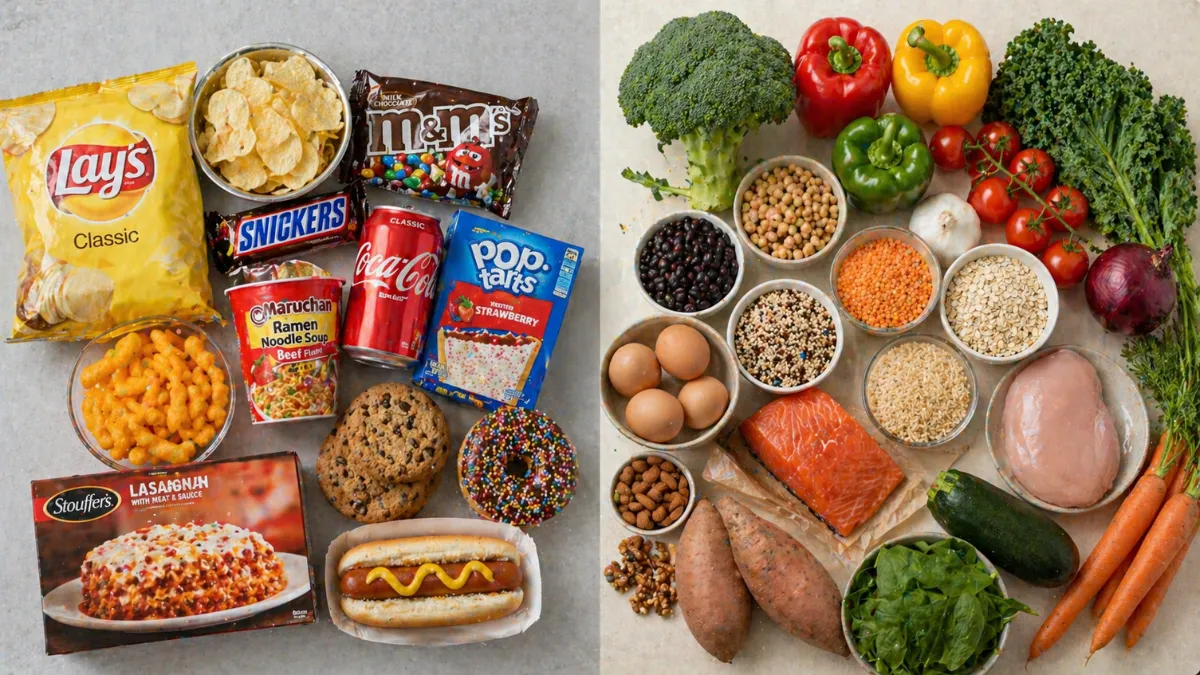
A calorie deficit created through whole-food consumption produces substantially different physiological effects than an equivalent deficit created through ultra-processed foods, even when macronutrient ratios appear similar on paper.
| Factor | Whole-Food Caloric Restriction | Ultra-Processed Caloric Restriction |
|---|---|---|
| Satiety per 100 kcal | High (fiber, water, protein matrix) | Low (rapid oral processing, minimal chewing) |
| Ghrelin suppression | Pronounced and sustained | Transient, rapid rebound |
| Postprandial glucose | Gradual rise, controlled insulin | Sharp spike, reactive hypoglycemia risk |
| Thermic effect of food | 15–25% of energy content | 5–10% of energy content |
| Gut peptide response | Robust GLP-1, PYY, CCK release | Blunted satiety hormone secretion |
| Spontaneous next-meal intake | Lower | Higher |
| Muscle preservation | Supported with adequate protein | Compromised by low protein density |
| Adherence at 12 months | Moderately high | Low |
The Ultra-Processed Food Trap
Ultra-processed foods are engineered for rapid consumption and minimal satiety. They are typically energy-dense, mechanically soft, and low in intact fiber, requiring less chewing and spending less time in the oral cavity. This alters the cephalic phase of digestion and reduces early satiety signaling. A controlled feeding study published in Cell Metabolism in 2019 demonstrated that individuals consuming an ultra-processed diet spontaneously ate 500 kcal more per day than those on an unprocessed diet matched for presented calories, protein, fat, carbohydrates, sugar, sodium, and fiber.
Advising someone to simply eat less while consuming a diet high in ultra-processed foods sets them against potent biological and food-engineering forces that make adherence nearly impossible. The quality of the caloric restriction matters as much as the quantity.
Evidence-Based Approaches That Work With Biology
Effective weight loss requires creating an energy deficit without triggering the full force of the body’s famine-response systems. Several strategies have demonstrated efficacy in clinical research.
1. Prioritize Protein and Resistance Training
Protein intake of 1.6–2.2 g per kg of body weight, combined with two to three weekly resistance training sessions, preserves lean mass during caloric restriction and blunts the drop in resting metabolic rate. Protein also provides the highest satiety per gram of any macronutrient and carries a thermic effect of 20–30%, meaning a significant portion of protein calories is expended during digestion. A person consuming 100 g of protein daily expends roughly 80–120 kcal simply processing it.
-
Distribute protein across meals: 25–35 g per meal stimulates muscle protein synthesis and satiety optimally.
-
Prioritize leucine-rich sources: dairy, eggs, poultry, fish, soy.
-
Combine protein with fiber at each meal for additive satiety effects.
2. Implement Diet Breaks and Refeed Periods
Continuous caloric restriction downregulates thyroid function and leptin more severely than intermittent restriction interspersed with maintenance eating. Diet breaks—periods of one to two weeks eating at estimated maintenance calories—partially reverse the hormonal adaptations to restriction.
A 2017 randomized controlled trial published in the International Journal of Obesity compared continuous caloric restriction to an intermittent approach with two-week diet breaks every two weeks of restriction. The intermittent group lost more fat mass and preserved more resting energy expenditure after 16 weeks. The psychological benefit of planned breaks also improved adherence and reduced the sense of deprivation that drives binge-eating episodes.
3. High-Volume, Low-Energy-Density Eating
Maximizing food volume within calorie constraints provides mechanical gastric distention that triggers stretch receptors in the stomach wall, signaling satiety through vagal afferent pathways. Foods with high water and fiber content—vegetables, fruits, legumes, whole grains, broth-based soups—provide substantial volume per calorie.
A large salad or vegetable soup consumed before a main meal reduces total meal energy intake by 100–200 kcal without requiring conscious portion control. This preloading strategy takes advantage of the satiety cascade, allowing individuals to eat until comfortably full while still maintaining a net energy deficit.
4. Address Sleep and Stress
Sleep restriction of fewer than six hours per night increases 24-hour energy intake by 200–400 kcal and shifts food preferences toward high-carbohydrate, high-fat items. Cortisol elevation from poor sleep amplifies hunger and directly promotes visceral fat storage. Treating sleep as a non-negotiable component of weight management, rather than an afterthought, removes one of the primary drivers of spontaneous overeating.
When Eating Less Becomes Dangerous
Caloric restriction becomes medically concerning when intake falls below basal metabolic needs for extended periods or when it intersects with psychological vulnerability.
Very Low-Calorie Diets and Medical Supervision
Very low-calorie diets, defined as fewer than 800 kcal daily, produce rapid weight loss but require medical supervision. Risks include electrolyte disturbances, cardiac arrhythmias, gallstone formation, and refeeding syndrome upon reintroduction of normal eating. These diets are appropriate only in specific clinical contexts, typically as a bridge to bariatric surgery or for individuals with severe obesity-related comorbidities where rapid weight loss is medically indicated. They should never be self-prescribed.
Disordered Eating and Restriction
For individuals with a history of anorexia nervosa, bulimia nervosa, binge eating disorder, or orthorexic tendencies, intentional caloric restriction of any kind carries significant risk. The cognitive behavioral pattern of restriction often triggers binge episodes in susceptible individuals, creating a cycle that worsens both physical and psychological health. Weight management in these populations requires specialist eating disorder-informed care, not generalized caloric reduction advice.
Populations That Should Not Restrict
Caloric restriction is contraindicated during pregnancy and lactation, childhood and adolescence (except in structured pediatric obesity treatment), active recovery from eating disorders, and certain medical conditions including advanced cancer cachexia, active infection, and immediate post-surgical recovery. Older adults require careful consideration of protein and micronutrient adequacy due to age-related anabolic resistance and increased risk of sarcopenia.
Practical Framework: Eating Less Intelligently
For individuals without contraindications seeking sustainable weight loss, a structured approach that minimizes the biological backlash follows these parameters.
Deficit size: 300–500 kcal below maintenance, not below. Large deficits accelerate metabolic adaptation. A moderate deficit preserves lean mass, minimizes hunger elevation, and maintains NEAT.
Protein minimum: 1.6 g per kg body weight daily, distributed across meals. This represents roughly 25–30% of total energy intake in a moderate deficit.
Resistance training: Two to three sessions weekly, targeting all major muscle groups. This preserves metabolically active tissue and improves body composition independent of scale weight changes.
Fiber intake: 25–35 g daily from intact whole-food sources. Fiber slows gastric emptying, feeds beneficial gut microbiota producing short-chain fatty acids, and reduces energy absorption through fecal energy loss.
Meal timing consistency: Three main meals with predictable spacing reduces extreme hunger episodes that drive impulse eating. Allowing 10–12 hours overnight without eating supports metabolic health.
Diet breaks: After 8–12 weeks of consistent deficit, a 1–2 week maintenance period restores some hormonal balance and psychological flexibility before resuming if further weight loss is needed.
Conclusion
The truth about eating less for weight loss is that it works, but not simply, and not for long when applied crudely. The human body possesses redundant, overlapping defense systems against energy deficit that evolution honed over millions of years. Treating weight loss as a matter of caloric arithmetic without accounting for the metabolic, hormonal, and neurological counter-response guarantees the high recidivism rates that characterize most diet attempts.
Effective weight management requires eating less intelligent, not just eating less. This means creating a moderate deficit through high-satiety, high-protein, high-fiber whole foods. It means preserving muscle with resistance training to protect metabolic rate. It means using diet breaks to partially reset the hormonal adaptations that continuous restriction produces. It means recognizing that sleep quality, stress management, and food environment design are not ancillary concerns but central determinants of spontaneous energy intake.
For some individuals, particularly those without a history of obesity or metabolic disease, modest caloric reduction through the strategies outlined in this article will produce sustainable weight loss without significant biological resistance. For others, particularly those with longstanding obesity or repeated weight cycling, the body’s defense of a higher set point may require medical support beyond dietary modification alone. Recognizing when self-directed efforts have reached their physiological limit is not failure; it is an indication to seek appropriate clinical evaluation, which may include pharmacotherapy or bariatric intervention.
The instruction to eat less, stripped of context and nuance, has produced decades of unnecessary suffering and self-blame. Replacing it with a physiologically informed, evidence-based approach to energy balance allows individuals to work with their biology rather than against it, achieving results that persist beyond the typical diet timeline.
FAQ — People Also Ask
Q: Why am I not losing weight when I’m eating less?
A: Metabolic adaptation reduces energy expenditure as intake drops, narrowing your deficit. Water retention, reduced NEAT, muscle loss, and inaccurate intake estimation also contribute. A plateau after 4–6 weeks of consistent undereating often signals adaptive thermogenesis, not failure.
Q: How few calories is too few?
A: For most adults, sustained intake below 1,200 kcal (women) or 1,500 kcal (men) risks micronutrient deficiencies, muscle wasting, gallstone formation, and metabolic slowdown. Very low-calorie diets below 800 kcal require medical supervision and are appropriate only in specific clinical contexts.
Q: Does eating less slow down metabolism permanently?
A: Metabolic rate drops during caloric restriction partly due to tissue loss and partly due to adaptive downregulation. The adaptive component partially reverses upon refeeding, though individuals with a history of significant weight cycling may exhibit persistent metabolic adaptation requiring higher protein intake and resistance training to offset.
Q: Can I build muscle while eating less?
A: In a moderate caloric deficit with adequate protein (1.6–2.2 g/kg), resistance training beginners and individuals with higher body fat can simultaneously lose fat and gain muscle. Trained lean individuals should not expect significant muscle gain in a deficit; preservation becomes the realistic goal.
Q: Is intermittent fasting just another way to eat less?
A: Intermittent fasting often reduces spontaneous caloric intake by limiting the eating window, but its primary mechanism for weight loss is indeed caloric reduction. Some evidence suggests modest metabolic advantages independent of calorie intake, but total energy balance remains the dominant factor determining weight change.
References
https://www.who.int/news-room/fact-sheets/detail/healthy-diet
https://www.niddk.nih.gov/health-information/weight-management/adult-overweight-obesity
https://pubmed.ncbi.nlm.nih.gov/21902805/
https://pubmed.ncbi.nlm.nih.gov/31105044/
https://pubmed.ncbi.nlm.nih.gov/11010936/
https://pubmed.ncbi.nlm.nih.gov/28825411/
https://www.nhs.uk/live-well/healthy-weight/managing-your-weight/
https://pubmed.ncbi.nlm.nih.gov/32779919/
https://www.cdc.gov/healthy-weight-growth/losing-weight/index.html
https://pubmed.ncbi.nlm.nih.gov/20847729/
https://www.efsa.europa.eu/en/topics/topic/dietary-reference-values