
📌 Key Takeaways
- Over 80% of weight loss attempts fail within 12 months — and the primary reasons are psychological, not physiological.
- The brain’s reward circuitry treats highly palatable foods similarly to addictive substances, making willpower an unreliable long-term strategy.
- Stress, sleep deprivation, and negative self-talk each independently increase the likelihood of weight regain through distinct neurobiological pathways.
- Cognitive behavioral techniques, implementation intentions, and identity-based habit formation are among the most evidence-supported psychological tools for sustained dietary change.
- Shame and guilt following dietary lapses are clinically documented to increase — not decrease — the likelihood of continued overeating.
The Psychology of Weight Loss: Why You Keep Failing
Most people who attempt weight loss know exactly what they should do. They understand calories. They have tried meal plans. They have downloaded the apps, bought the food scales, and started with genuine motivation — only to find themselves, weeks or months later, back at square one or further behind than when they started. The problem is not knowledge. It is not discipline. It is neuroscience.
The human brain did not evolve to support voluntary, sustained caloric restriction in an environment of abundant, hyper-palatable food. The same neurological systems that evolved to drive survival — reward, stress response, habit formation, emotional regulation — now work systematically against the behavioral changes required for weight loss.
Understanding these mechanisms is not an academic exercise. It is the foundational requirement for building any weight loss approach that actually lasts. This article is written for adults who have tried and failed, and who want a clinical understanding of why — and what the evidence says actually works.
The Neuroscience of Food Reward: Why Willpower Is Not Enough
The mesolimbic dopamine system — sometimes called the brain’s reward pathway — assigns motivational salience to behaviors that historically promoted survival: eating, particularly calorie-dense food, triggers dopamine release in the nucleus accumbens. This reward signal does not simply create pleasure. It generates anticipatory craving, compels repetition of the behavior, and encodes the environmental cues associated with the reward into powerful habit loops.
Ultra-processed foods are specifically engineered to maximize this dopaminergic response. The combination of fat, sugar, salt, and texture in processed snacks, fast food, and sweetened beverages produces reward signals that exceed those of natural whole foods by a significant margin. Over time, repeated exposure to these hyperpalatable stimuli can reduce dopamine receptor sensitivity — a tolerance-like phenomenon that drives increased consumption to achieve the same reward signal.
Why Restriction Amplifies Craving
Paradoxically, caloric restriction intensifies the reward salience of food. When the brain perceives food scarcity — through actual restriction or psychological restraint — it upregulates craving for calorie-dense foods as a survival response. This is why people on restrictive diets often develop intrusive, persistent thoughts about the specific foods they are avoiding — a phenomenon behavioral researchers term ironic process theory: the deliberate suppression of a thought reliably increases its frequency.
Willpower — the executive control function of the prefrontal cortex — can override the reward system temporarily. But it is a finite, depletable cognitive resource. Decision fatigue, stress, poor sleep, and emotional distress all reduce prefrontal cortex function, tipping the neurological balance toward the reward-seeking impulses of the limbic system. Relying on willpower as the primary strategy for sustained dietary change is therefore a structural mismatch between the tool and the problem.
Emotional Eating: The Stress-Cortisol-Craving Loop
The relationship between psychological stress and food intake is bidirectional and neurobiologically specific. Chronic stress elevates cortisol — the primary glucocorticoid stress hormone — which directly increases appetite, particularly for calorie-dense, palatable foods. Cortisol activates neuropeptide Y, a potent appetite stimulant, while simultaneously reducing sensitivity to leptin, the satiety hormone.
Beyond the hormonal mechanism, eating serves a genuine short-term emotional regulation function. High-sugar, high-fat foods temporarily activate the brain’s opioid receptors, producing a brief reduction in perceived stress and anxiety. This is why emotional eating is not irrational or weak — it is a learned coping mechanism with real, if transient, neurological efficacy. The problem is that it creates a cycle: stress drives eating, eating produces guilt, guilt generates further stress, which drives further eating.
Identifying Personal Stress-Eating Triggers
Effective intervention requires mapping the specific antecedents of stress-eating for each individual. Common trigger categories include:
- Interpersonal conflict or social stress (work relationships, family tension, social comparison)
- Performance pressure and deadline-related anxiety
- Boredom and low stimulation states, which the brain registers similarly to mild stress
- Sleep deprivation — which independently elevates ghrelin and reduces satiety hormone activity
- Environmental food cues — visual or olfactory exposure to palatable foods in stress states
- Negative self-evaluation — particularly body image criticism and weight-related self-judgment
Stress management is therefore not peripheral to weight management. It is central. Interventions that reduce cortisol burden — including regular physical activity, sleep optimization, mindfulness-based stress reduction (MBSR), and social support — directly improve dietary self-regulation through their effects on the stress-craving pathway.
Psychological Barriers to Weight Loss: Mechanism and Evidence-Based Response
| Psychological Barrier | Neurobiological Mechanism | Evidence-Based Response |
| Willpower depletion | Prefrontal cortex fatigue reduces executive control over reward impulses | Reduce decision load; automate dietary defaults; use implementation intentions |
| Emotional / stress eating | Cortisol drives craving for hyperpalatable foods; eating provides opioid-mediated relief | Develop alternative stress regulation strategies; MBSR; cognitive reframing |
| Post-lapse guilt spiral | Shame activates all-or-nothing thinking; abandonment of goals follows minor deviation | Practice self-compassion; adopt ‘next meal’ recovery mindset; reframe lapses as data |
| Unrealistic goal-setting | Mismatch between expectations and results triggers demotivation and abandonment | Set process goals, not outcome goals; use small wins for dopamine reinforcement |
| Habit interference | Existing food habits are encoded in basal ganglia; high automaticity resists change | Context disruption; habit stacking; environmental redesign |
| Negative self-efficacy | Low belief in capacity to change predicts early abandonment | Cognitive behavioral restructuring; self-efficacy building through small successes |
| Social environment pressure | Social norms and peer food cues powerfully influence intake behavior | Communicate goals to social network; restructure eating environment; prepare responses |
| Body image distortion | Inaccurate body perception drives shame-based motivation, which is fragile | Separate body image work from weight loss goals; health-centered motivation framing |
The Habit Architecture of Eating Behavior
Most eating is not consciously decided. A substantial proportion of daily food choices are habitual — executed automatically in response to environmental cues, without deliberate deliberation. The basal ganglia, the neural structure governing habit execution, encodes cue-routine-reward sequences that become increasingly automatic with repetition. Once established, food habits are resistant to change not because of weakness, but because of neuroplasticity: the neural pathways supporting the habit are physically reinforced through repeated activation.
Understanding habit architecture provides concrete intervention points:
- The cue: the trigger that initiates the habitual behavior (time of day, location, emotional state, visual food exposure)
- The routine: the habitual eating behavior itself (reaching for a snack, ordering a particular meal, eating while watching screens)
- The reward: the neurological payoff that reinforces the cycle (dopamine release, stress relief, sensory pleasure, social belonging)
Replacing vs. Eliminating Habits
Neurological research on habit modification consistently demonstrates that eliminating an established habit is substantially harder than replacing it. The cue-reward structure of an existing habit can be retained while substituting a new routine that delivers a compatible reward. For example: the afternoon energy slump cue that drives a trip to the vending machine can be redirected toward a protein-rich snack consumed at the desk — same cue, modified routine, similar reward (energy restoration).
Environmental redesign is among the most evidence-supported tools for habit modification in dietary behavior. Because habits are cue-driven, removing the environmental triggers — clearing hyperpalatable snacks from visible countertops, restructuring the kitchen to make healthy foods the default visible option, changing the route that passes a fast food outlet — reduces the frequency of habitual eating behaviors without requiring active willpower suppression.
Self-Sabotage, Identity, and the Abstinence Violation Effect
One of the most clinically significant phenomena in weight loss psychology is the abstinence violation effect (AVE): the tendency for a single dietary deviation to trigger complete abandonment of the behavioral goal. The mechanism is cognitive — the deviation is interpreted as evidence of fundamental personal failure rather than as an isolated event, activating all-or-nothing thinking patterns and undermining self-efficacy to a degree disproportionate to the actual dietary impact of the deviation.
A person who has eaten well for six days and then overeats at a social event has not failed. Metabolically, one overeating episode has minimal impact on overall energy balance across days. Psychologically, however, the AVE can transform this minor deviation into a complete dietary collapse — the ‘I’ve already ruined it, I might as well continue’ pattern that behavioral clinicians observe as one of the primary drivers of weight regain.
Identity-Based Habit Formation
Behavioral research suggests that the most durable dietary changes occur when they are anchored to identity rather than outcomes. Motivation framed as ‘I am trying to lose weight’ is outcome-focused and contingent on results — making it vulnerable to discouragement when progress is slow or non-linear. Motivation framed as ‘I am someone who treats my body well’ or ‘I prioritize nutritious food’ is identity-based and more resilient to temporary setbacks because each healthy food choice becomes an act of self-consistency rather than a performance against a target.
This shift is not semantic. Identity-based framing activates different cognitive processes: self-consistency motivation is more resistant to the AVE because a single deviation does not invalidate the identity, whereas it can invalidate a weight-loss goal in progress.
Sleep, Cognitive Function, and Dietary Self-Regulation
Sleep deprivation is one of the most underrecognized contributors to weight gain and dietary failure. A single night of insufficient sleep (less than 6 hours) produces measurable increases in ghrelin, reductions in leptin, impaired prefrontal cortex function, and increased activation of brain reward regions in response to food cues — a neurobiological state that simultaneously increases appetite, reduces satiety, degrades executive control, and amplifies the reward salience of unhealthy food choices.
Chronic sleep restriction — 5–6 hours per night over weeks — produces cumulative metabolic and cognitive impairments that rival those of acute total sleep deprivation. Adults who consistently sleep fewer than 7 hours per night have significantly higher rates of obesity, impaired glucose metabolism, and dietary self-regulation failure compared to those sleeping 7–9 hours.
Sleep optimization is therefore a direct nutritional intervention. The evidence supporting sleep duration as a modifier of weight loss outcomes is robust enough that registered dietitians and behavioral health clinicians increasingly incorporate sleep assessment and intervention into weight management protocols.
Psychological Strategies That Actually Work
Implementation Intentions
Implementation intentions are specific ‘if-then’ plans that link anticipated situational cues to pre-decided behavioral responses. Instead of a vague goal (‘I will eat better’), an implementation intention specifies: ‘If I am at a social event with unhealthy food options, then I will eat before I arrive and choose protein-based options at the event.’ Meta-analytic research demonstrates that implementation intentions significantly increase goal achievement rates across health behavior domains.
Cognitive Behavioral Nutrition Therapy
Cognitive behavioral therapy (CBT) adapted for eating behavior targets the thought patterns — perfectionism, black-and-white thinking, catastrophizing about lapses, negative body image beliefs — that directly undermine dietary adherence. CBT-based weight management programs produce superior long-term outcomes compared to dietary education alone, because they address the cognitive distortions that drive behavioral relapse.
Self-Compassion as a Clinical Tool
Counterintuitively, self-compassion — treating oneself with the same kindness offered to a close friend following a setback — is associated with better long-term dietary adherence than self-criticism. The mechanisms include reduced shame-driven eating, lower cortisol response to dietary lapses, and greater willingness to re-engage with health goals after deviation. Self-compassion does not reduce motivation; it protects it.
Practical strategies that support psychological success in weight management include:
- Setting weekly behavioral process goals (cooking three meals at home, eating a vegetable at every dinner) rather than weight-outcome targets
- Conducting brief daily self-reflection on hunger, mood, and eating patterns — without judgment or calorie tracking
- Building a social environment that supports dietary goals — communicating intentions to household members, meal prepping with a partner
- Using the ‘next meal’ recovery principle: any deviation ends at the next meal, not at the next Monday or next month
- Separating body image goals from health goals — pursuing health behaviors for functional reasons (energy, strength, longevity) rather than appearance-based motivations that are tied to shame
Shifting the Framework: From Discipline to Design
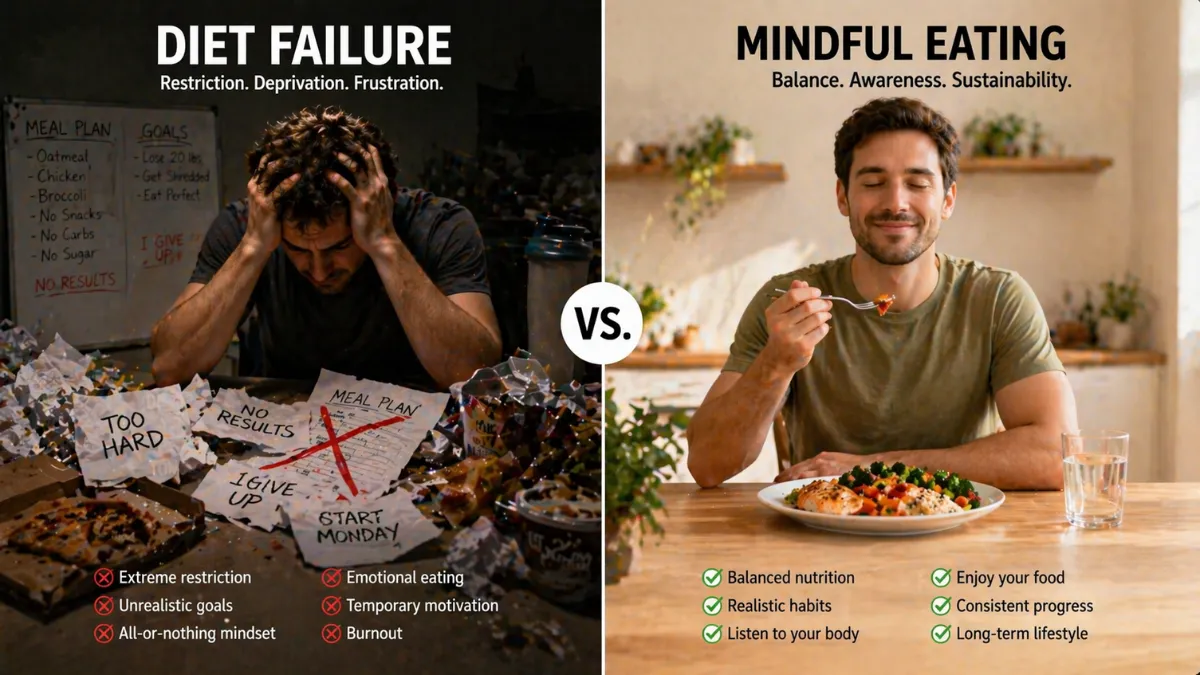
Weight management failure is not a character flaw. It is a predictable outcome of attempting to use willpower-based strategies against neurobiological systems that operate with far greater power and persistence than conscious intention. The most clinically durable weight management approaches share a common design principle: they work with human psychology rather than against it.
Practical application means making healthy eating the default rather than the deliberate choice. It means investing in sleep, stress management, and emotional regulation as dietary interventions. It means replacing shame-based motivation with identity-based habit formation. It means building environments where the path of least resistance leads toward nutritional adequacy rather than away from it.
The goal is not perfect adherence. The goal is a behavioral architecture resilient enough that lapses are recovered from quickly, that the general direction remains forward, and that dietary patterns become genuinely self-sustaining rather than dependent on the finite, depleting resource of willpower. The psychology of weight loss is ultimately the psychology of sustainable change — and sustainable change requires designing systems, not summoning discipline.
FAQ — People Also Ask
Q: Why do I always fail at weight loss after a few weeks?
The early weeks of weight loss benefit from novelty motivation and initial results. As novelty fades, existing habits reassert themselves, motivation becomes outcome-dependent, and stress or social events trigger behavioral lapses. Without a psychological framework for managing these predictable obstacles, abandonment follows a consistent timeline.
Q: Is emotional eating a disorder?
Occasional emotional eating is a common, normal behavior. It becomes clinically significant when it is the primary coping mechanism for negative emotion, occurs frequently regardless of hunger, and produces significant distress or health consequences. Binge eating disorder (BED) is a diagnosable condition with evidence-based treatment options, including CBT and specific pharmacological interventions.
Q: Can mindfulness really help with weight loss?
Mindfulness-based interventions reduce emotional eating, improve awareness of hunger and satiety cues, decrease binge eating frequency, and lower stress-related cortisol — all mechanisms directly relevant to weight management. Mindfulness does not replace dietary change; it supports the behavioral regulation required to sustain it.
Q: How do I stop self-sabotaging my diet?
Self-sabotage most commonly reflects unrealistic expectations, all-or-nothing thinking, and shame-based motivation. Replacing outcome goals with behavioral process goals, using implementation intentions for high-risk situations, and practicing self-compassion following lapses are clinically validated approaches that reduce self-sabotage patterns.
Q: Does stress actually cause weight gain?
Yes, through multiple mechanisms. Elevated cortisol increases appetite (particularly for calorie-dense foods), reduces leptin sensitivity, promotes visceral fat deposition, impairs sleep quality, and degrades the prefrontal executive function required for dietary self-regulation. Stress management is a direct weight management intervention, not a peripheral concern.
References
- https://www.ncbi.nlm.nih.gov/pmc/articles/PMC4380831/
- https://pubmed.ncbi.nlm.nih.gov/23364002/
- https://www.ncbi.nlm.nih.gov/pmc/articles/PMC3428710/
- https://pubmed.ncbi.nlm.nih.gov/17452369/
- https://www.ncbi.nlm.nih.gov/pmc/articles/PMC4207953/
- https://pubmed.ncbi.nlm.nih.gov/28193517/
- https://www.ncbi.nlm.nih.gov/pmc/articles/PMC2764929/