
📌 Key Takeaways
| • Low-carb diets produce 1.3-3.3 kg more weight loss than low-fat diets at 6-12 months, but differences largely disappear after one year.
• Low-carb diets significantly reduce triglycerides and raise HDL; low-fat diets better reduce LDL and total cholesterol. • For people with type 2 diabetes, low-carb diets produce greater HbA1c reductions and may enable medication reduction within 6-12 months. • Adherence is the dominant predictor of long-term success with either approach. |
Introduction
Two dietary strategies have dominated weight management and metabolic health research for decades: reducing carbohydrates or reducing fat. Both promise weight loss, both have passionate advocates, and both are backed by clinical trial data. Yet the public debate has often produced more confusion than clarity.
The question is not simply which diet causes more weight loss — it is which diet produces better outcomes for specific health goals, specific individuals, and specific metabolic conditions. A person managing type 2 diabetes has different priorities than someone seeking cardiovascular risk reduction, and a 35-year-old with metabolic syndrome has different needs than a healthy adult trying to lose 5 kilograms.
This article examines the peer-reviewed clinical evidence comparing low-carbohydrate and low-fat diets across weight loss, blood lipids, blood sugar control, long-term adherence, and metabolic health. The goal is not to declare a winner, but to give you a clear, evidence-based framework for choosing the approach most likely to work for you.
Defining the Two Approaches
What Is a Low-Carb Diet?
A low-carbohydrate diet restricts total carbohydrate intake, typically to fewer than 130 grams per day — with very low-carb (ketogenic) versions limiting intake to 20–50 g/day. Calories from carbohydrates are replaced primarily by dietary fat and, to a lesser extent, protein. Common food patterns include unrestricted meat, fish, eggs, dairy, nuts, seeds, non-starchy vegetables, and avocado, while bread, pasta, rice, legumes, and most fruit are significantly reduced or eliminated.
What Is a Low-Fat Diet?
A low-fat diet restricts total fat intake to less than 30% of total daily calories, with saturated fat ideally below 10%. This approach does not explicitly limit carbohydrate intake but in practice shifts calories toward carbohydrates and protein. Standard low-fat dietary advice emphasizes lean proteins, whole grains, legumes, fruits, vegetables, and low-fat dairy. Total calorie intake is typically also restricted, making most low-fat trials energy-restricted by design.
Weight Loss: Short-Term Advantage for Low-Carb, Long-Term Equivalence
The most clinically robust evidence comes from meta-analyses of randomized controlled trials. A 2020 meta-analysis of 38 RCTs involving 6,499 adults found that low-carbohydrate diets produced a mean weight loss advantage of 1.3 kg compared to low-fat diets at 6–12 months. This advantage was statistically significant but modest in absolute terms.
Earlier pooled analyses observed even larger short-term differences — up to 3.3 kg greater loss at 6 months — but these advantages consistently narrowed by 12–24 months, at which point weight loss outcomes converged between the two dietary patterns.
The short-term advantage of low-carb diets is partly explained by:
- Rapid initial glycogen and water depletion (each gram of glycogen holds 3–4 g of water)
- Enhanced satiety from higher protein and fat content, reducing spontaneous calorie intake
- Appetite-suppressing effects of ketone body production in very low-carb conditions
- Reduced insulin secretion leading to lower fat storage signalling
Critically, the long-term convergence of outcomes does not indicate that low-carb diets stop working — it reflects that adherence to both approaches declines over time, and total caloric deficit remains the primary driver of sustained fat loss regardless of macronutrient composition.
Blood Lipids: Each Diet Has a Different Profile
The lipid effects of the two diets diverge clearly and have important implications for cardiovascular risk assessment.
Low-Carb Diets and Lipids
Across multiple meta-analyses, low-carbohydrate diets consistently produce significant reductions in serum triglycerides and meaningful increases in HDL (high-density lipoprotein) cholesterol — changes associated with improved cardiometabolic risk. However, LDL (low-density lipoprotein) cholesterol often rises on low-carb diets, particularly on ketogenic versions with high saturated fat intake. This rise varies substantially between individuals and appears more pronounced in those who carry the ApoE4 genotype.
Low-Fat Diets and Lipids
Low-fat diets demonstrate a more favorable effect on LDL and total cholesterol. The 2020 meta-analysis quantified a mean 0.07 mmol/L lower LDL in low-fat diet groups compared to low-carb groups. For individuals at elevated cardiovascular risk with already-elevated LDL, this distinction may be clinically meaningful.
The critical caveat for low-fat diets is that their benefits depend heavily on what replaces dietary fat. Substituting fat with refined carbohydrates and added sugars — a common real-world pattern — can worsen triglycerides and reduce HDL, negating the intended cardiovascular benefit.
Blood Sugar Control and Type 2 Diabetes
This is the domain where evidence most consistently favors low-carbohydrate approaches, at least in the short to intermediate term.
A 2024 meta-analysis of RCTs in overweight and obese adults with type 2 diabetes reported that low-carb dietary interventions produced significant reductions in HbA1c levels within 6–12 months compared to low-fat diets. These glycemic improvements were accompanied by reduced fasting blood glucose and lower insulin requirements — with some participants in controlled trials able to reduce or discontinue diabetes medication.
Research published in 2024 in the Journal of Clinical Endocrinology & Metabolism found that adults with type 2 diabetes on a low-carbohydrate diet showed improvements in acute beta-cell function that were twice those seen in high-carbohydrate diet groups — a finding with significant implications for disease progression and medication dependency.
The American Diabetes Association and Diabetes Canada both now formally recognize low-carbohydrate eating patterns as effective dietary strategies for managing type 2 diabetes.
Key glycemic benefits of low-carb diets in T2DM populations include:
- Reduced postprandial blood glucose spikes by limiting dietary carbohydrate load
- Lower insulin demand, reducing pancreatic beta-cell stress
- Improved HbA1c by an average of 0.5–1.0% in multiple trials at 6 months
- Potential for partial or full remission in a subset of patients with early-stage T2DM
However, glycemic benefits of low-carb diets tend to diminish after 12–24 months, suggesting that long-term adherence is required to sustain improvements — a significant practical challenge for many patients.
Head-to-Head Comparison: Low-Carb vs Low-Fat
| Feature | Low-Carb Diet | Low-Fat Diet |
| Carb limit | ≤ 20–100 g/day | No strict limit; fat < 30% kcal |
| Fat intake | High (50–75% of calories) | Low (< 30% of calories) |
| Protein | Moderate to high | Moderate |
| Short-term weight loss | Greater (−1.3 to −3.3 kg advantage) | Moderate; calorie-dependent |
| Long-term weight loss (>12 mo) | Similar to low-fat | Similar to low-carb |
| Triglycerides | Significantly reduced | Modest reduction |
| HDL cholesterol | Increased | Little change |
| LDL cholesterol | May increase (type-dependent) | Reduced |
| Blood glucose / HbA1c | Significant improvement (T2DM) | Modest improvement |
| Insulin sensitivity | Comparable to low-fat | Comparable to low-carb |
| Hunger / satiety | High satiety (protein + fat) | More hunger in some individuals |
| Best for | T2DM, metabolic syndrome, insulin resistance | Heart disease risk reduction, LDL management |
| Main risks | Elevated LDL, nutrient gaps, adherence | Refined carb substitution, possible weight rebound |
Choosing the Right Approach: Individual Factors Matter
Low-Carb May Be Better If:
- You have type 2 diabetes or prediabetes and want tighter glycemic control
- You have high triglycerides, low HDL, or metabolic syndrome
- You find high-fat, high-protein foods more satisfying and easier to sustain
- You want more rapid initial weight loss as a motivational tool
- You do not have a history of elevated LDL or familial hypercholesterolaemia
Low-Fat May Be Better If:
- You have elevated LDL or a strong family history of cardiovascular disease
- You are taking statins and managing total cholesterol
- You prefer grain-based foods, legumes, and fruit and find them easier to sustain
- You follow plant-based or vegetarian patterns where fat restriction aligns naturally
- You are at risk for kidney stones (oxalate concerns with very high-fat diets)
Important Caveats
A 2024 longitudinal study from Monash University tracking nearly 40,000 adults over 17 years found that low-carbohydrate diets were associated with a 20% increased risk of developing type 2 diabetes — driven largely by higher obesity incidence in that cohort. The researchers emphasized that this risk applies specifically when low-carb diets lead to weight gain over time and do not reflect the experience of well-formulated, nutrient-dense low-carb approaches. The findings underscore that diet quality, not macronutrient ratio alone, determines long-term metabolic outcomes.
Practical Meal Frameworks
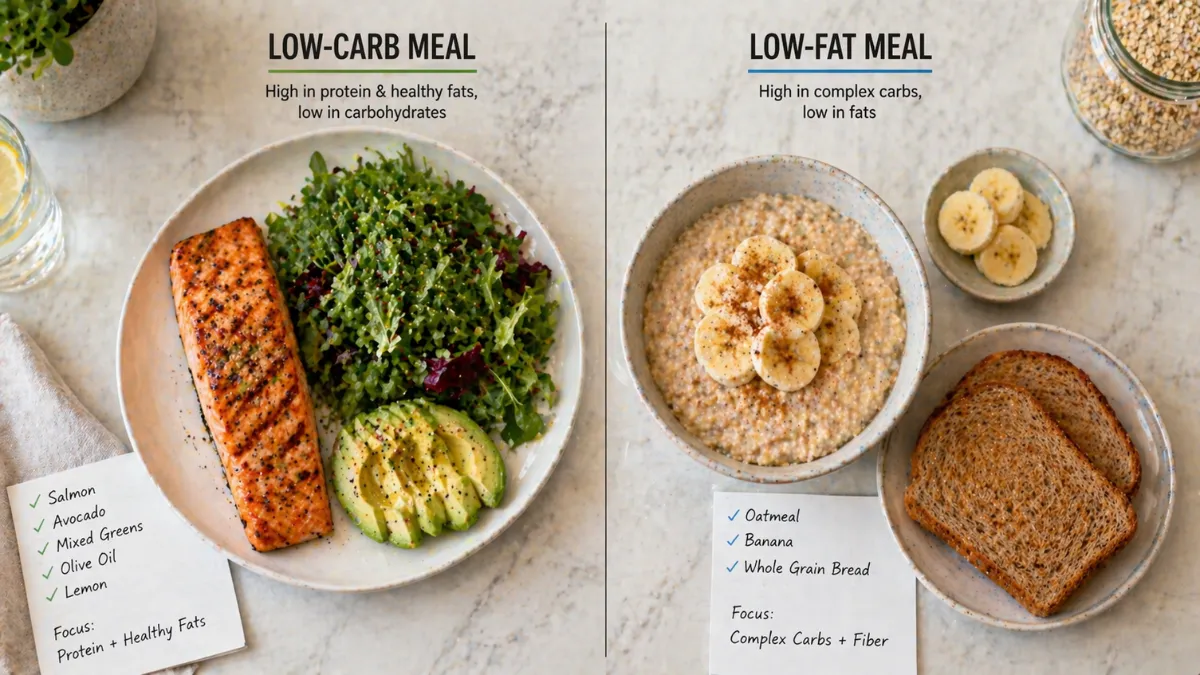
Low-Carb Day (Approximately 1,800 kcal)
- Breakfast: 3 eggs scrambled with spinach and feta, cooked in olive oil (~350 kcal, 3g carbs)
- Lunch: Grilled salmon with mixed greens, avocado, cucumber, and olive oil dressing (~500 kcal, 8g carbs)
- Snack: 30g almonds + 2 tablespoons hummus with celery sticks (~250 kcal, 10g carbs)
- Dinner: Grilled chicken thighs with roasted broccoli and cauliflower mash (~600 kcal, 15g carbs)
- Total estimated carbs: ~36g | Total fat: ~110g | Protein: ~140g
Low-Fat Day (Approximately 1,800 kcal)
- Breakfast: Oatmeal with skimmed milk, banana, and a drizzle of honey (~380 kcal, 68g carbs, 4g fat)
- Lunch: Lentil soup with crusty whole-grain bread and a small side salad (~480 kcal, 72g carbs, 5g fat)
- Snack: Non-fat Greek yogurt with berries (~150 kcal, 20g carbs, 0.5g fat)
- Dinner: Baked cod with steamed brown rice and stir-fried vegetables in minimal oil (~550 kcal, 65g carbs, 6g fat)
- Total estimated fat: ~18g | Total carbs: ~225g | Protein: ~110g
The Adherence Problem: Why the Best Diet Is the One You Can Sustain
A persistent finding across long-term dietary trials is that adherence is the most powerful predictor of sustained weight loss and metabolic improvement — regardless of which macronutrient is restricted. Both low-carb and low-fat diets produce comparable long-term outcomes precisely because dietary adherence declines similarly in both groups over time.
A large 2018 Stanford DIETFITS trial (n=609) found no significant difference in 12-month weight loss between low-fat and low-carbohydrate diets and found that neither genotype nor baseline insulin secretion reliably predicted which diet would be more effective for a given individual.
This evidence supports a person-centred approach: the optimal diet is the one aligned with food preferences, cultural practices, lifestyle demands, and metabolic history that can be followed consistently over months and years — not the one with the theoretically superior macronutrient profile.
Conclusion
The clinical evidence does not support declaring an unconditional winner between low-carb and low-fat diets. What the evidence does support is matching dietary strategy to individual health goals and metabolic profile.
If your primary concern is blood sugar management, insulin resistance, or type 2 diabetes, a low-carbohydrate approach offers a well-supported, guideline-recognized advantage — particularly in the first 6–12 months. If your primary concern is LDL cholesterol reduction and cardiovascular risk, a low-fat diet with emphasis on whole food carbohydrate sources and lean proteins is the more evidence-backed choice.
For general weight loss in otherwise healthy adults, both approaches are effective when adhered to consistently. Focusing on whole, minimally processed foods — regardless of which macronutrient is restricted — addresses diet quality factors that underpin most of the metabolic benefit attributed to either pattern.
Before making significant dietary changes, particularly if you have an existing metabolic condition, consult a registered dietitian or physician who can tailor recommendations to your individual health status, medications, and goals.
FAQ — People Also Ask
Q: Is low-carb or low-fat better for losing belly fat specifically?
Both approaches reduce visceral (abdominal) fat when a consistent calorie deficit is maintained. Low-carb diets may preferentially reduce visceral fat in individuals with metabolic syndrome, but evidence across healthy populations is mixed. Total calorie reduction and physical activity remain the primary drivers.
Q: Can I follow a low-carb diet if I have high cholesterol?
It depends on which cholesterol markers are elevated. If you have elevated LDL, particularly with cardiovascular disease risk, a low-fat diet is generally preferred. If your concern is elevated triglycerides and low HDL (common in metabolic syndrome), low-carb may be beneficial. Consult your physician and check lipid panels regularly if you change dietary patterns.
Q: How long does it take to see results on a low-carb diet vs low-fat diet?
Low-carb diets typically produce faster visible results in the first 1–4 weeks, partly due to water and glycogen loss. Low-fat diets produce steadier, more gradual weight loss. At 3–6 months, both approaches show meaningful results when adhered to consistently.
Q: Which diet is better for someone with type 2 diabetes?
Low-carbohydrate diets have stronger short-to-medium term evidence for improving HbA1c, fasting blood glucose, and potentially reducing medication requirements in type 2 diabetes. Both the American Diabetes Association and Diabetes Canada recognize low-carb as a valid management strategy. Always adjust any diet change in coordination with your prescribing physician if you are on glucose-lowering medication.
Q: Do I need to count calories on a low-carb or low-fat diet?
Low-fat diets typically require calorie restriction to achieve weight loss. Low-carb diets are often practiced ad libitum (without explicit calorie counting), relying on appetite suppression from protein and fat. In practice, both approaches benefit from some degree of calorie awareness, particularly if weight loss stalls after the initial phase.
References
https://pubmed.ncbi.nlm.nih.gov/33317019/
https://pmc.ncbi.nlm.nih.gov/articles/PMC9397119/
https://pubmed.ncbi.nlm.nih.gov/39145286/
https://pmc.ncbi.nlm.nih.gov/articles/PMC8500369/
https://www.frontiersin.org/journals/nutrition/articles/10.3389/fnut.2024.1376098/full
https://pmc.ncbi.nlm.nih.gov/articles/PMC11743357/